Hydrogen vs. Electric Trains: The Engineering Behind Zero-Emission Rail
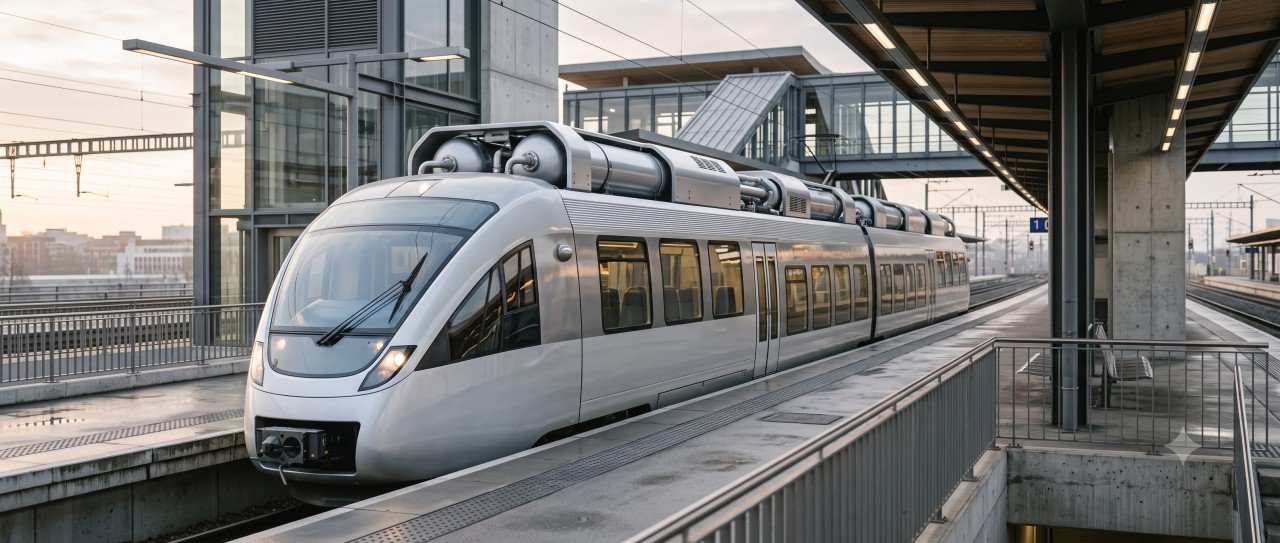
If you’ve spent any time in a thermodynamics or power systems course, you’ve probably heard your professor mention hydrogen fuel cells as “the technology of the future.” That future just got a lot more concrete. In July 2026, India joined a small club of countries — Germany, Japan, and China — running hydrogen-powered passenger trains in daily commercial service. It’s a good moment to actually break down how these trains work, why hydrogen is suddenly viable for heavy transport, and what it means if you’re an engineering student trying to figure out where the clean-energy job market is headed.
This isn’t just a transportation story. It’s a systems engineering story — one that touches mechanical, electrical, and chemical engineering all at once. Let’s get into it.
Why Trains Are a Hard Problem for Clean Energy
Most of the conversation around electric vehicles focuses on cars, and for good reason — that’s where battery technology has matured fastest. But trains are a different beast entirely.
A single passenger train can weigh several hundred tons and needs to sustain that load over hundreds of kilometers, often through terrain where laying new overhead electric wires is either impossible or absurdly expensive. Batteries alone don’t scale well for this: the weight of a battery pack large enough to move a multi-car train the required distance would eat into passenger and cargo capacity, and recharging infrastructure at that scale doesn’t exist on most non-electrified routes.
That’s the gap hydrogen fuel cells are designed to fill.
How a Hydrogen Fuel Cell Train Actually Works
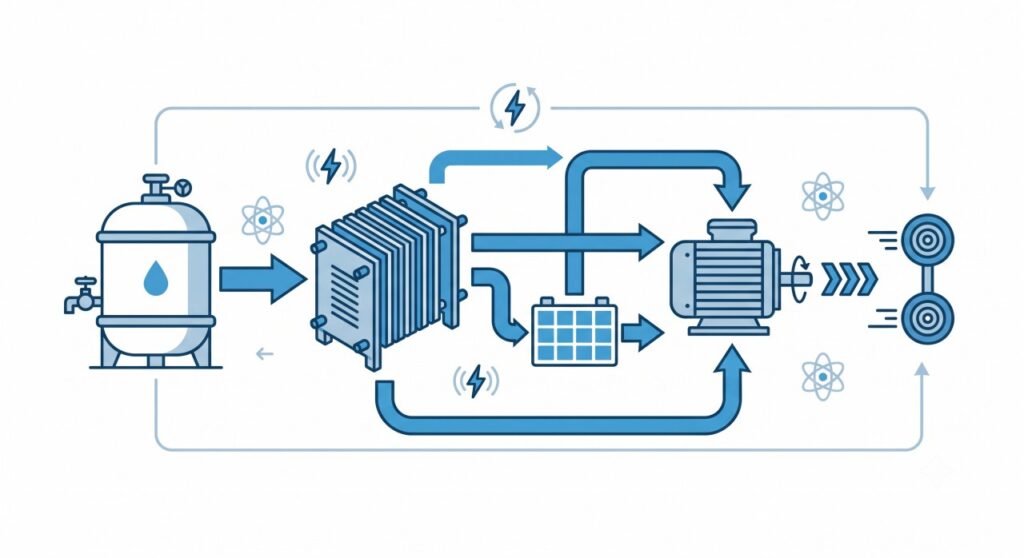
At the core of every hydrogen train is a proton exchange membrane (PEM) fuel cell stack. Here’s the simplified version of the energy chain:
- Hydrogen storage — Compressed hydrogen gas is stored in tanks mounted on the roof or undercarriage of the train.
- The fuel cell reaction — Hydrogen combines with oxygen pulled from the surrounding air inside the fuel cell stack. This electrochemical reaction produces electricity, with water vapor as the only byproduct — no combustion, no CO2.
- Power delivery — The electricity generated drives traction motors, the same basic principle used in electric trains, except the power source is onboard rather than an overhead catenary line.
- Battery buffering — Most hydrogen trains pair the fuel cell with a lithium-ion battery buffer. The battery smooths out power delivery during acceleration and captures energy from regenerative braking, which improves overall efficiency.
The elegant part of this design is that it borrows the drivetrain of a standard electric train — traction motors, inverters, control systems — and simply swaps the power source. That’s a big reason hydrogen trains have moved from prototype to commercial service faster than some other clean-energy transport technologies: the electrical engineering underneath is already mature.
The Global Hydrogen Rail Landscape
Hydrogen rail isn’t a single-country experiment anymore. It’s becoming a genuine international engineering trend, and each country’s approach highlights a different piece of the puzzle.
Germany was first to commercial passenger service, with Alstom’s Coradia iLint entering regular operation in Lower Saxony back in 2018 — the world’s first hydrogen passenger train. Germany’s approach has focused on replacing diesel multiple units (DMUs) on regional lines that were never going to be worth electrifying.
Japan has approached hydrogen rail as part of a broader national hydrogen economy strategy, tying train development to the same fuel cell R&D that powers Toyota’s hydrogen vehicle program.
China has been testing hydrogen and hydrogen-hybrid trainsets as part of a wider push to decarbonize freight and regional rail without the capital cost of full electrification.
India’s entry in July 2026 is notable for scale and intent. Indian Railways flagged off its first hydrogen-powered passenger service on the 89-kilometer Jind–Sonipat route in Haryana, developed at the Integral Coach Factory in Chennai. It’s the opening move in a stated plan to deploy roughly three dozen hydrogen trains on non-electrified and ecologically sensitive routes over the coming years — corridors where stringing overhead electric wire would be both expensive and environmentally disruptive.
Put together, these four countries are running a live, global engineering experiment: is hydrogen fuel cell propulsion actually cheaper and more practical than full electrification for the routes that don’t justify overhead wires?
Hydrogen vs. Electric vs. Diesel: A Quick Comparison
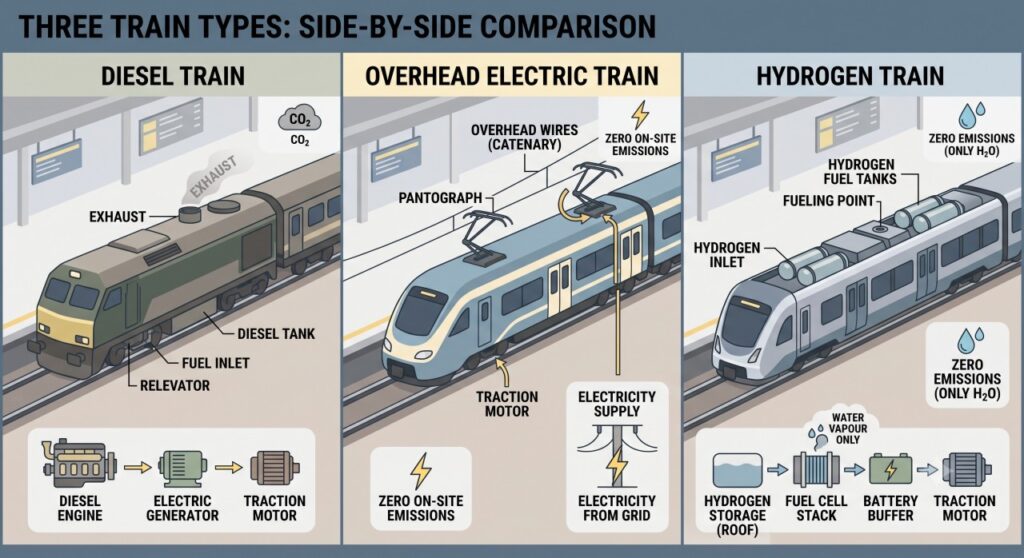
| Factor | Diesel-Electric | Overhead Electric | Hydrogen Fuel Cell |
|---|---|---|---|
| Emissions | High (CO2, NOx, particulates) | Zero at point of use (depends on grid mix) | Zero (water vapor only) |
| Infrastructure cost | Low (uses existing track) | Very high (catenary wiring, substations) | Moderate (hydrogen refueling stations) |
| Range flexibility | High | Limited to electrified track | High — no fixed wiring needed |
| Refuel/recharge time | Fast | N/A (continuous power) | Fast (minutes, similar to diesel) |
| Best use case | Legacy routes, low investment | High-density, high-traffic corridors | Non-electrified regional and scenic routes |
The takeaway for engineers: hydrogen isn’t trying to replace overhead electrification on busy commuter corridors. It’s competing with diesel on the routes where full electrification doesn’t pencil out financially — and on that specific battlefield, it’s starting to win.
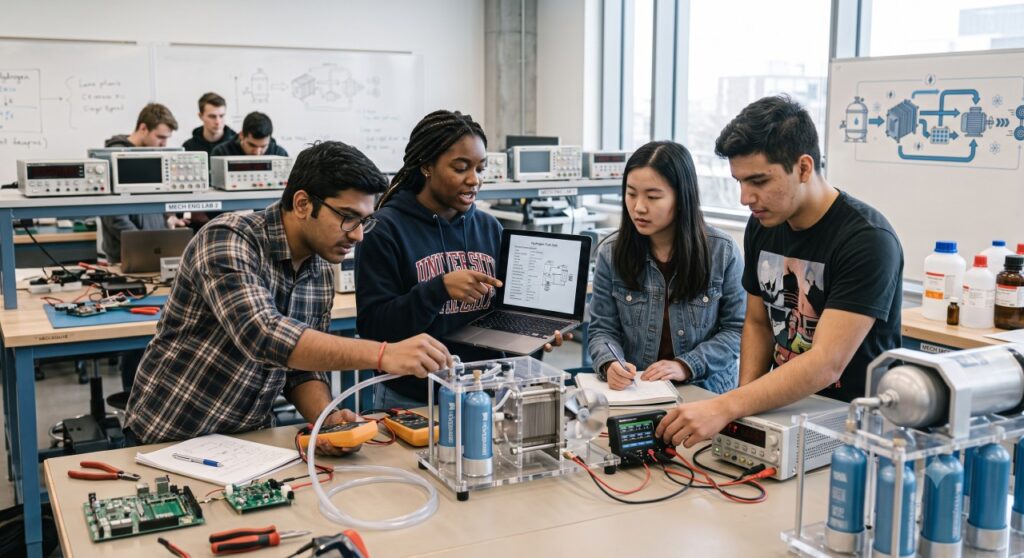
Why This Matters If You’re an Engineering Student
This is where the story stops being trivia and starts being relevant to your career planning.
Mechanical and aerospace engineering students will find direct overlap in fuel cell thermal management, hydrogen storage tank design (composite pressure vessels are their own specialized field), and structural weight optimization — problems that show up in hydrogen aviation and hydrogen trucking too, not just rail.
Electrical engineering students should pay attention to power electronics: converting fuel cell DC output into usable traction power, managing the battery-fuel cell hybrid system, and designing the control logic that balances the two power sources in real time.
Chemical engineering students are the ones who actually make green hydrogen possible in the first place — electrolysis efficiency, catalyst design for PEM fuel cells, and hydrogen storage chemistry are all active, well-funded research areas right now.
Computer science and CS majors aren’t off the hook either. Fuel cell systems generate enormous amounts of sensor data that needs real-time processing for safety-critical control — predictive maintenance models, anomaly detection in fuel cell degradation, and embedded systems programming for traction control are all software-heavy problems inside a “mechanical” project.
In the US specifically, this translates into real hiring demand. The Department of Energy’s Hydrogen Shot initiative and a growing number of hydrogen hub projects funded under federal infrastructure programs have created a steady stream of internships and entry-level roles at companies working on fuel cells, electrolyzers, and hydrogen logistics. If you’re building out a resume or looking for a senior capstone project, a hydrogen energy systems project is one of the more resume-relevant choices you can make right now — it signals you understand both the electrochemistry and the systems engineering, which is a combination recruiters in this space specifically look for.
The Honest Limitations
It’s worth being straight about where hydrogen rail still struggles, because understanding the limitations is as important as understanding the appeal — and it’s exactly the kind of nuance that separates a surface-level summary from something you could actually discuss in an interview.
Round-trip efficiency is poor. Producing green hydrogen through electrolysis, compressing it, transporting it, and then converting it back to electricity in a fuel cell loses a significant chunk of energy at every step. A battery-electric train, where the grid connects almost directly to the wheels, is meaningfully more energy-efficient end to end. Hydrogen wins on flexibility and range, not on efficiency.
Refueling infrastructure is still sparse. A hydrogen train is only as useful as the hydrogen refueling stations along its route, and building that infrastructure from scratch is a real capital cost, even if it’s cheaper than full electrification.
Green hydrogen supply is limited. Not all hydrogen is created equal. “Green” hydrogen, produced via electrolysis powered by renewables, is still a small fraction of global hydrogen production, most of which currently comes from natural gas. The climate benefit of a hydrogen train depends heavily on how the hydrogen itself was made.
FAQ
The Bottom Line
Hydrogen rail is no longer a lab curiosity — it’s a commercial technology with trains running daily service across four continents’ worth of countries in 2026. For engineering students, it’s a useful case study in exactly the kind of systems-level thinking your coursework is trying to build toward: no single discipline “owns” the problem. It’s mechanical, electrical, chemical, and computational engineering solving one transportation challenge together. That’s worth understanding regardless of which corner of engineering you end up specializing in.